Signal Power and Coexistence with other Radio Equipment
A common misconception in RF system design is that two radio systems cannot influence each other as long as they operate on different frequencies. In reality, frequency separation alone does not guarantee isolation.
A useful analogy is visible light. A small red LED and a small green LED can easily be distinguished because they emit different wavelengths. Replace the green LED with a powerful spotlight, however, and the red LED becomes difficult to see—not because its colour changed, but because the much stronger light dominates the environment.
The same principle applies to radio systems. Even when signals occupy different frequency bands, a sufficiently strong transmitter can overload receiver front ends, raise the effective noise floor, generate intermodulation products, or couple into nearby antennas and electronics. As a result, weaker signals may become difficult or impossible to detect despite operating on different frequencies.
This effect is particularly relevant in modern venues where tracking systems share the RF environment with wireless video links, Wi-Fi networks, wireless microphones, in-ear monitoring systems, mobile phones, and many other radio devices.
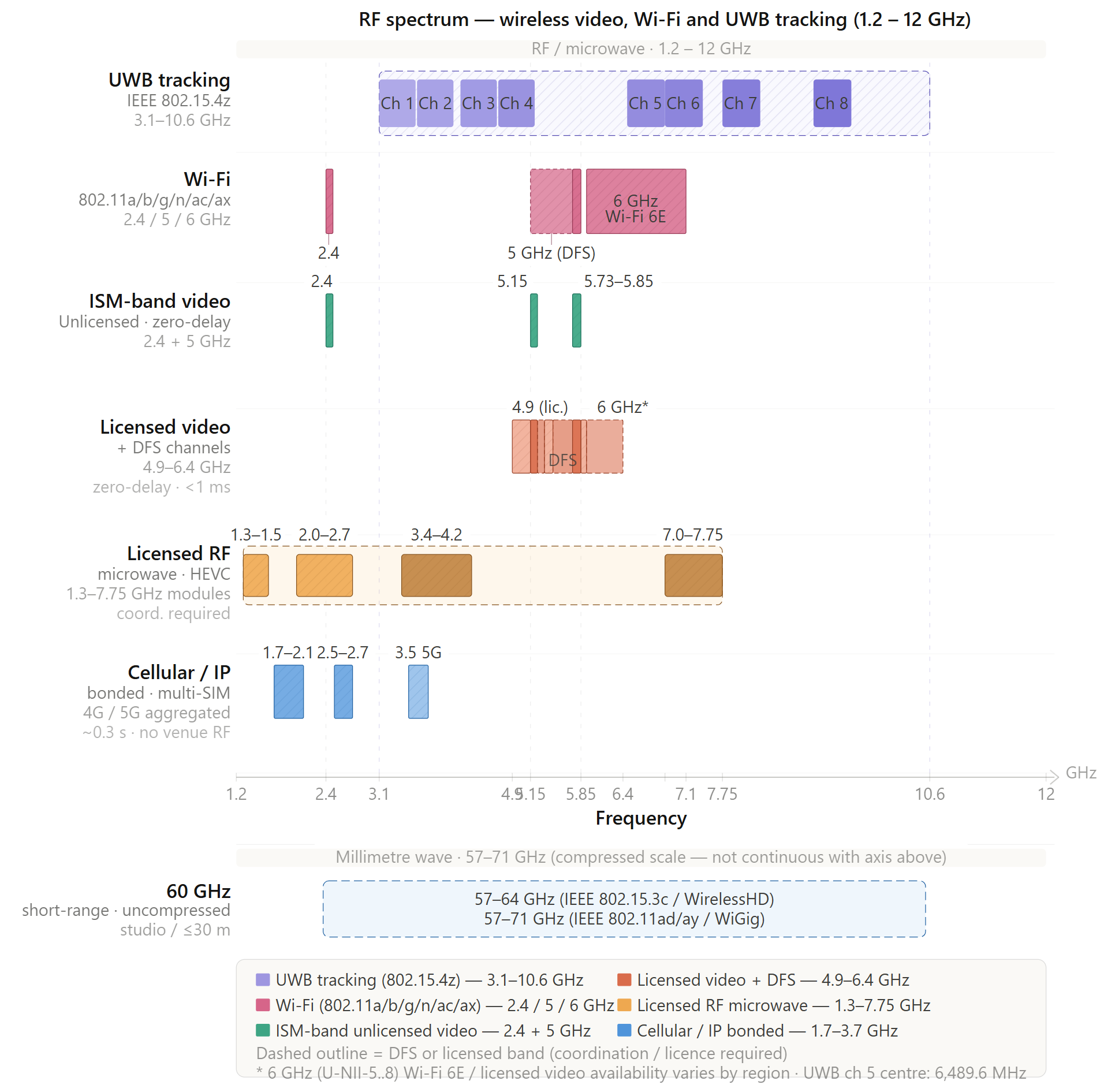
For example, zactrack MINI and SMART operate on UWB Channel 5, centered at 6489.6 MHz and occupying approximately 6.24–6.74 GHz. zactrack PRO can alternatively operate on Channels 1–3 (approximately 3.5–5.0 GHz) to avoid congested spectrum areas.
 |
Signal Power
The power comparison between UWB and conventional radio systems is often misunderstood. UWB regulations are usually specified as power spectral density, while most radio transmitters are specified as total EIRP power.
As of 2026, indoor UWB operation in the European Union is permitted at –31.3 dBm/MHz (–41.3 dBm/MHz plus the additional 10 dB indoor allowance introduced in recent regulations).
To compare this with a conventional radio transmitter, the power must first be integrated across the occupied bandwidth:
For a typical UWB bandwidth of 500 MHz:
This means that a UWB transmitter occupying 500 MHz bandwidth radiates approximately –14.3 dBm total power.
Compared to a conventional radio transmitter operating at 33 dBm EIRP, the difference becomes:
A difference of 47 dB corresponds to roughly 54,000 times more transmitted power.
In practical terms, a 33 dBm transmitter is enormously stronger than a UWB signal. UWB is only permitted to occupy such large bandwidths because its power density is extremely low. Consequently, a nearby high-power transmitter can significantly reduce tracking performance or even prevent reliable ranging altogether, while the UWB system has virtually no measurable impact on the stronger radio system.
Practical Advice
Fortunately, these issues are usually manageable with careful RF planning:
Separate anchors from transmitters.
Place zactrack anchors as far as possible from wireless video transmitters and other high-power RF devices. Physical separation remains the most effective mitigation.
Coordinate RF from the start.
Treat the 6.24-6.74 GHz range as a protected zone for Channel 5 operation where possible, or switch zactrack PRO to Channels 1–3 if the 6 GHz spectrum is already occupied.
Stay within certified EIRP limits.
Excessive transmit power directly increases the risk of overloading nearby UWB receivers.
Prefer non-RF transport methods in dense environments.
Fibre-based or network-based transmission systems can reduce the RF load inside the venue.
Perform a spectrum scan during setup.
A sweep across approximately 5.5–7 GHz can reveal unexpected or misconfigured transmitters before they affect the show.
Note
As with most RF challenges, successful coexistence depends less on frequency allocation alone and more on understanding and managing the complete radio environment.